Showing posts with label Personal. Show all posts

Sunday, June 7, 2015

Singapore Weather & Updates

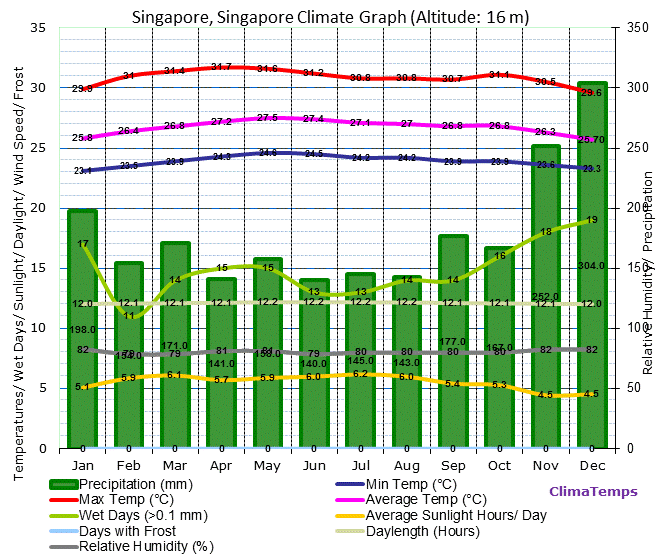
The Singapore (Paya Lebar) climate is characterised by uniform temperature and pressure, high humidity and abundant rainfall. The climate of Singapore can be divided into two main
seasons, the Northeast Monsoon and the Southwest Monsoon season, separated by two
relatively short inter-monsoon periods.

North-East Monsoon Season - December to early March - Northeast winds prevail,
sometimes reaching 20 km/h. Cloudy conditions in December and January with frequent
afternoon showers. Spells of widespread moderate to heavy rain occur, lasting from 1 to 3
days at a stretch. Relatively drier in February till early March. Also generally windy with wind speeds sometimes reaching 30 to 40 km/h in the months of January and February.

Pre South-West Monsoon - late March to May - Light and variable winds with afternoon and early evening showers often with thunder.

South-West Monsoon Season - June to September - Southeast/Southwest Winds. Isolated to scattered late morning and early afternoon showers. Early morning 'Sumatra' line squalls are common. Hazy periods.

Pre North-East Monsoon - October to November - Light and variable winds. Sea breezes in the afternoon. Scattered showers with thunder in the late afternoon and early evening.

Temperatures range from 19.4 deg C to 35.8 deg C. There is no distinct wet or dry season. Rainfall maximum occur in December and April. The drier months are usually in February and July.


=======================================================

Apologies for going missing for an extended period of time as I was swamped with materials to study as well as a hectic training schedule. Managed to clear CAAS Form 32 and Base Check, with the next stage being Base Training with the airline. The pace at which things went in the past six weeks was amazing and everything went by in a blink of an eye.

I'll try to keep up with the backdated posts and update this post with the links below.


Backdated Posts:-


Sunday, April 5, 2015

Week 93: A320 Type Rating Week 32

Session #1
The very first time I was scheduled to train at the last time slot of the day, with an ending time of 12 midnight. It feels a little bit more tiring and my brain don't seem to be as active as day time. I guess I'll have to deal with this in real line flying.

This session consist of two new objectives, mainly Managed/Managed NPA and Windshear recovery. Previously we've only tried flying CANPA manually as well as in Select/Select Mode with AP via LOC button and FPA. Managed NPA is a way to reduce he workload of the PF so that he can better focus on a wider angle of view.

However, the amount of preparation and criteria that is required before we push that APPR button is not the least bit lesser. First and foremost, the GPS Accuracy will have to be HIGH. Believe it or not, even if both the VORs on the aircraft are down, it is still able to fly a Managed VOR approach, thanks to the coordinates of the station being programmed into the FMGC database.

Next, sequence the flight plan and check that all heights and speeds coincide with the approach chart. There will be a green little solid dot beside the altitude indicator to show whether the aircraft is high or low on approach. Height checks will have to be called out too just like before. The biggest problem comes with where the VOR station is located with respect to the runway. Tracking into the VOR doesn't necessarily mean it will be the same track of the runway. As a result, last minute track changes will need to be executed and this is not necessarily an easy move, especially when we were given 15kts crosswind. It would not have been a problem if the weather is good enough to attain visual of runway from pretty far away. However, the same can't be said if conditions are near minimums.

Lastly, windshear recovery on take-off climb and approach. I was quite stunned by the amount of motion involved in windshear, so much so that after numerous hits with windshear, I got kind of motion sick. It is really a scary experience when flying into one, especially on approach. I had to execute TOGA thrust and announce WINDSHEAR TOGA if it was during take-off climb. The PM have to call out the RA and V/S (eg. RA 400, V/S 2500 positive) constantly to make sure the aircraft is climbing and not being dragged onto the ground.

As for approach, the drag towards the ground when flown into windshear makes my balls shrink. It's no laughing matter as the motion from the sim will not be a gentle one if you crash the plane. If the landing is not going to be safe, WINDSHEAR GO-AROUND will be called, TOGA thrust set and the PM will call out the RA and V/S. During the period when the aircraft is within the windshear, it has to remain in its original config. Flaps/Slats and gear will be left untouched.


My sim partner and I were exhausted and hungry after the midnight end time, plus the motion sickness, it wasn't a good feeling at all. Went for a really late supper at 1am to end of the day. Haha, more of such scheduling and we will both be fat very soon.


Session #2
A big session considering the amount of new things included for the whole four hours. TCAS, EGPWS, Low Speed Protection and further practise on turbulent plus strong crosswind landing.

First up, introduction to TCAS. TCAS stands for Traffic Collision Avoidance System. This is the only device in the aircraft that allows the pilot to disobey ATC instructions. I will share a video below on why is this so. TCAS provides Traffic Advisory(TA) and Resolution Advisory(RA). For RA to work, the aircraft must have a transponder. TA will only alert the pilot on surrounding traffic whereas RA will call out instructions for the pilot to Climb/Descend. When that happens, the PF will announce "TCAS, I Have Control" and place his hands on the thrust levers and side stick, ready to disengage the AP and climb/descend to the green region of the VSI. At the same time, PM will notify ATC "TCAS RA", and then "Clear of Conflict" when there is no more danger, if a RA was called out by the TCAS. PF will resume original altitude and navigation after the TCAS warning.

Next was EGPWS warning. It stands of Enhanced Ground Proximity Warning System. When flying in IMC, this will be the instrument that will save your life, along with the Radio Altimeter. The most crucial warning is "Terrain, Terrain, Pull Up, Pull Up". Upon hearing this, PF will disconnect AP, TOGA thrust and climb immediately. Any further delay and you'll end up in headline news the next day. While climbing out of terrain, PM will call out RA heights for PF's situation awareness.

Finally to Low Speed Protection of the A320. We tested this by selecting the climb speed to 6000fpm! With the Autothrust on and in Speed mode, the aircraft will try to achieve the selected climb rate, until the speed gets too low and the system will stop it at VLS then adjust the climb rate so that the aircraft doesn't go into stall. The same happens when the descend rate is selected at -6000fpm and the speed increased to close to VMO before it stops there and adjust the descend rate.

Rounding up the session was landing in turbulent conditions with 20kts crosswind component. Even though green First Officers in the company will not be flying anything more than 10kts, this is good practice and a confidence builder. Windshear is also added into the situation to spice things up. Interestingly, I managed to land with windshear on approach using manual thrust without the windshear warning coming on. My problem with crosswind landing is inconsistency as I tend to flare too much and/or bank into wind too much.

Crosswind approach


Sunday, March 29, 2015

Week 92: A320 Type Rating Week 31

After the confidence booster session I had in the full motion sim last week, I was raring to have another go at it this week. This time it will be heck lot more challenging with poorer weather conditions.

ATIS: 15kts crosswind, night, 5000m, heavy rain, wet runway with good braking action

Just like last week, we had to do visual circuits from take-off with full stop, and a circle to land from a Non-precision approach. Visual circuits were flown at two different altitudes; twice for each level, mainly 1500ft and 1000ft AGL.

1500ft circuit was without much issue as the thrust reduction and acceleration altitudes are at 800ft and 1200ft respectively just like last week. The 1000ft circuit is a little different with both of them at 800ft AGL, so the reaction gotta be real quick to anticipate thrust and flying attitude change before hitting 1000ft AGL to fly level.

Since the weather wasn't really that great plus it was at night, I had to use a lot of my ND to maintain awareness. The base turn was the most challenging aspect as getting visual with the papi and runway lights really required a lot of visual power. Sometimes, I'm able to see it but my PM can't and vice-versa. The trouble with spotting the runway late, resulted in a pretty messy final approach, but my landings were safe and close to centreline even with that strong crosswind.

The same goes for circling to land, but this time with a localiser only approach to simulate NPA. And also going-around during downwind leg, when you really gotta be aware of where you are and where you are flying next for the missed approach procedure. It is all about situation awareness and be prepared for a go-around when unstable or lost visual. So far, so good.


==============================================


Had a meeting with the airline management this week and is glad that they're able to absorb us into the fleet but with some sacrifices on our side for a period of time. At the end of the day, I'm just relieved that I have such a caring company who think about our welfare and try their best to improve our situation, which I deeply appreciate.

When I embarked on this journey some 29 months ago, I've been yearning for the day I can truly call myself a professional aviator. The journey has thus far been long and arduous, braking and accelerating on numerous occasions. But waiting is a norm in this industry, so I can't really complain but to grind it out and make sure I train proficiently to display the level of professionalism expected of me day in day out. Expected completion is within the next three months, a final sprint before a new chapter begins.


This week also witnessed the passing of Singapore's founding father, Mr Lee Kuan Yew. He is a great loss to Singapore but his legacy will live. Singapore Airlines was set up by him and he has a vision for Changi Airport which we are witnessing today, a world class aviation hub. He can be said to be the pioneer of Singapore aviation. 

Thank you for all that you've done for us since 1955 when you stepped into parliament. Had Singapore had a different prime minister then, things would have been very different. You spirit will always live in us. May you rest in peace.


SIA pilots bidding him final farewell


Friday, March 20, 2015

Week 91: A320 Type Rating Week 30

This week marks the start of Phase 3 training. From now onwards, I will only fly in the full motion simulator. I was a little worried about motion sickness the night before my training. I'm not exactly a fan of roller coaster either.

As a familiarization training, it was only a short 2-hour session with each cadet flying for one hour. Lesson objective was to fly two visual circuit pattern, two touch&go and two straight-in 6miles final approach.

It was my first try at circuit flying on the A320, and it's quite differently flown as compared to the C172 type of circuit.

Thrust reduction: 800ft 
Acceleration altitude: 1200ft 
Circuit height: 1600ft 

Heights are based on Changi Runway 02C with elevation of 22ft.

Circuit was flown fully with raw data, without FD, A/THR, AP and ILS. Everything happens very quickly in the circuit. Flex/MCT for take-off, gear up with positive climb, flying attitude at 15degrees nose up, pull back to CLIMB thrust at 800ft which is very easily attained, thus the probability of missing it is quite high. Hitting 1200ft lower nose to 10degrees for acceleration and cleaning up of flaps. Circuit speed shall be flown at Green Dot, which is roughly 200kts.

Upon leveling off at 1600ft, make a 25degrees right bank towards downwind track. Call for After Take-off/Climb Checklist once all flaps/gear/spoilers are retracted. Once done, activate APPROACH PHASE in the FMGC and call for Approach Checklist. Go-around altitude will be set on the FCU at downwind leg, along with Flaps 1 and setting S-speed.

Once abeam runway threshold, start chrono. For every 100ft AGL, the downwind leg will have to be flown for an added 3seconds after passing the abeam point, depending on wind conditions. In this case, we set it at 45seconds. At about 30seconds, Flaps 2 will be called and a 15degrees base turn towards final will be initiated at 45seconds. It will be a slight descend turn with rate at around -200fpm. In the base turn, gears will be lowered, followed by Flaps 3 and eventually Flap Full when nearing final leg. Runway track will be set and then Landing Checklist will be called once in full landing configuration.

Approach has to be stabilised by 500ft AGL, or a go-around will have to be called.

Not that easy eh? Haha.. The start was tough, but subsequent rounds of circuit flying became much better with practice. As for touch&go, the flying is the same, except that no spoilers, reverse thrust and autobrakes will be used. Upon touch down, PF will call for Flaps 2 and engage thrust lever in upright position for 2-3seconds before going TOGA with PM calling for rotate at Approach Speed since there is no Rotate Speed.


As for the feel of full motion as compared to the fixed base simulator I've been flying for the past seven months; it was an eye opener and kind of screwed up what I'm used to. The taxi feel is different as it's much more sensitive. The control stick is also less stiff and the input has no lag, making the flying somehow easier. The graphics is also more realistic, assisting in the lining up of runway centreline on approach. I had so much trouble flying visual circuit in the fixed base during circle-to-land, but this full motion totally changed my game and I'm flying way better now. It's quite a confidence booster when I'm able to land properly and be assured that all my previous landings in the fixed base were of correct technique.

Finally touching the full motion simulator and feeling like a real pilot


Sunday, January 4, 2015

Week 82: A320 Type Rating Week 21

I mentioned that I will update on the fatigue level by the end of the fifth consecutive sim session this week. Well, it wasn't as bad as expected, but probably a little jaded with all that engine-out procedures to think about and the handling of the situation during systems malfunctions. The good thing though, the SOP flow is getting more fluent now that we're all very familiar on what to do after doing it for five consecutive days.

There were a total of four sessions this week with a two-day break separating two pairs of sessions.

Session #1
Like the previous session the day before, we were still handling the situation of  engine failure after take-off. One added portion was the Go-Around during landing with one engine out. The yaw is immense and the climb rate is very poor, but at least the aircraft is capable of executing such a move with only half its power left. Catching the yaw with rudder is the key, or the plane and start rolling into dangerous parts of the airport.

No Memory Items, No FSI, No OEB, My Radios, ECAM Action!


Session #2
This was a very troublesome session which tested us on how to handle slats/flaps jam during extension. The very first thing to note is not to bust the Flaps speed. Immediately after the jamming has been displayed by the ECAM, we fly a Select speed of Vfe-next minus 5kts. The speed limits of different stages of flaps are conveniently located below the FCU panel so no memory work is required there.

After ECAM actions were carried out, we had to refer to the QRH on what speeds to adhere to for different stages of flight. Next, the DODAR will be carried out with the QRH being used extensively.

We have the fuel penalty to consider with the aircraft now experiencing more drag as well as the landing speed and landing distance required, plus weather conditions factored in. Quite a bit of table reference and calculations are needed to get the speeds and distances right.

I got the worst of the three types of jams with mine being jammed at Flaps 1 configuration. My approach speed was so high I was flabbergasted!! Then came the astounding attitude of the aircraft for the approach. My nose was 8degrees up and I was totally not used to such an approach attitude even though I had the FD to guide me for the ILS approach. I was cautious on the flare, so much so that I didn't really apply any pullback on the sidestick, With the speed so high, I can feel that the landing was hard, and my instructor commented that he didn't see any flare. The approach stunned my two other sim partners as well haha.

Session #3
Another session with Slats/Flaps jam, but this time the take-off was in Config 2 rather than the usual Config 1. Needless to say, the jamming will come right after take-off during retraction, as opposed to the previous session with it coming during extension.

There wasn't much difference from the previous session and I had a very high approach attitude again. This time round, I was able to execute the flare properly with my attitude just above 10degrees and not getting a tailstrike.

After two sessions of slats/flaps jam, I can conclude that it is quite a pain to handle with lots of QRH referencing. Nevertheless, this is what we're trained for, to handle abnormal situations appropriately.

Session #4
After slats/flaps jam, the next thing to jam was the Landing Gear! Good thing was this is way easier to handle with no QRH procedure as the gear failed to retract instead of the gear failing to extend. The latter situation will be heck lot more complicated I reckon. We had the gear lights not going off after retraction and the gear lever jammed in the DOWN position. But that didn't affect much of the flying except for added fuel consumption, especially if the PF decides to carry on flying to destination airport instead of returning. We selected to fly at Green Dot Speed while sorting out our options, noting that our landing weight might be higher than the Structurally limited Max Landing Weight since we've only just taken off and full load of fuel.

To make things more interesting, we were given the VOR CANPA approach. After flying ILS with FD approaches for so many sessions, some of us forgot how to fly a Non-precision approach correctly. Thankfully I took the lessons under CANPA flying very seriously back then and managed to manual fly the approach without any trouble. My sim partners got a little caught off guard with the ND view mode not selected correctly or not configuring the aircraft for an early stabilised approach which resulted in a pretty messy descend profile.

All these little things that were taught in the earlier part of the training are easy to forget I have to say, and there are a lot to remember and keep ourselves prepared for any situation to happen. Since we had quite a lot of time left after we've completed the lesson objective, our instructor gave us some serious crosswind landing training. We were taught the crabbing technique, with the flare+bank+rudder co-ordination skill to achieve a safe landing. But of course, if the crosswind is so strong, we are actually not allowed to land due to company safety policy. It was fun and very good training I must say, and my confidence to handle 40kts crosswind has just gone up a few notches!

40kts crosswind with a 20degrees crab angle. Almost shit in my pants.


==============================================

This week marked the end of 2014 and the start of a new year. Last year this time was spent overseas in Ballarat in the midst of my flight training. It feels better to be home this year.

2014 as a whole was fairly good with so many things happening in my life. I had an exciting January clearing my first solo flight in the C172 which I burst a tyre and feared for my life. February was a month filled with numerous solo circuit flights which were frustrating. March came and went like a wind with me flying my first solo navigation flight that was heart pounding as the weather was getting crazy and I tuned to the wrong radio frequency.

April was really painful with a huge number of flight cancellations due to poor weather conditions but it was also the month which I passed my PPL test; the first in my batch. May was the craziest month I had in Ballarat with almost 24hrs of flight hours. I had a week of consecutive flights prior to my return to Singapore. I was so happy to return after seven painfully slow months in Ballarat facing a climate which I rather not make friends with. June was the month I had my fill of local food as well as meeting up with friends which I hadn't seen since my departure.

July marked the start of A320 ground school and I had trouble adjusting my body and mind back to sitting in the classroom again attending lessons for the whole day. Very soon the ground school was over and my first sim session was conducted near the end of August, which shocked me with the steep learning curve in the cockpit. September reminded me how long ago it was since my course started as I had to get my Class 1 Medical renewed before it lapsed on the 24th month. Phase 2A of training was also completed by the end of the month.

October was the month which got me purring like an excited kid with two observation flights in a real A320 aircraft. That was a true eye opener! Training Phase 2B started in mid-month. November was largely uneventful as training came to a crawl with only 5 sessions for the whole month. And finally to December, when I sat for my last ever written exam at SAA and passed it. Phase 2B training was completed and Phase 2C commenced. 

A blink of an eye, year 2014 was concluded. It has been 26 months since I've embarked on this course. It's getting longer than I would have preferred, but with the current aviation industry facing a challenging business environment, this delay is expected. At least I have a job for me at the end of training, I just have to grind out this delay and hope things turn for the better.

I don't know what 2015 will bring, but hopefully things will go smoothly and I can finally say byebye to days as a cadet and become a professional aviator in the commercial world. I dare not think too far; one step at a time is what I'm telling myself these days.

Wishing my readers a great 2015 ahead~!!


Sunday, December 28, 2014

Week 81: A320 Type Rating Week 20

As of today, it is my third consecutive day of training in the simulator, and I'm set for another two consecutive days of training for the next two days after today. That makes it FIVE consecutive days of training! Already feeling a little tired today with all that travelling to&fro school plus four hours of training in the sim. Hopefully I'll be able to perform under such intense schedules, will update again on the level of fatigue on next week's update.

==============================================

Session #1
After having a taste of AP/FD with precision approaches last week, this session will teach us how to fly CANPA with FD. The biggest difference was the use of TRK/FPA instead of HDG/VS. It took some time to get used to as it looks way different on the PFD which makes it a little harder to follow.

For training, we will be flying the CANPA in a Select/Select mode, meaning to say Vertical Select and Lateral Select. On approach with either VOR or ILS without glideslope, the APPR button on the FCU will not be pushed. The ND view mode will have to be appropriately selected especially for VOR approaches. Using the TRK/FPA with FD, be fully configured for landing in an early stabilised approach. The FPA knob will be dialed to -3.0 degrees 1nm and pulled at 0.3nm before descend point respectively. This will move the Flight Path Director(FPD) into the -3.0 degrees descend flight path, and the pilot will manual fly by following it, which my instructor refer to as "fly the bird into the hole".

Check heights will be called out at respective distances and adjustments can be made to the FPD if the height is way off what it should be. Visual landing will resume upon hitting minimum and touch down will proceed as usual.

With the airline having attained approval from the authorities to fly CANPA in Managed/Managed mode, this will be much easier with the APPR button pushed.

Having a try at Managed NPA. This is how the FPD looks like.

Session #2
A very special training session with our first night flight with one engine in-operational. The difference in feel can be felt from the moment I stepped into the simulator. Just like night flights I had in Ballarat, working in dark environment is a new set of challenges.

First thing, the dome light has to be switched on for the pilots to do the paper work and other cockpit preparation efficiently. Next, the flood lights and screen panels will need to have their brightness adjusted for best night vision on the outside of the aircraft, or you might blind yourself.

Taxi speeds remain the same even in night conditions, additional light needed is the Runway Turn-Off lights. These lights shine the side of the taxiway at an angle to assist you in turning into a different taxiway. These sort of things can't be experienced during daylight. Everything is almost pitch dark once the aircraft leaves the gate with only the blue taxiway lights and runway lights visible.

Taking off, an engine failure was given by the instructor, with the usual things to do before heading back for landing. FD is being used and it was a single engine ILS approach. I was worried about landing at night as I have experienced in Ballarat, but my worries were not a concern when I saw how different it is landing in an international airport with the lights and Radio Altimeter assisting me with the flaring.

Night flight and this is how it looks

Simulated sunrise after a night flight. Well I guess this is the best feeling a pilot can get after a long night of work.


Session #3
To simulate a more realistic emergency situation, this lesson incorporated decision making procedures used by the airline. For this case, it is an engine failure after take-off. TOGA thrust is applied upon a failure is detected and reflected on the ECAM, to climb to the Minimum Safe Altitude of the aerodrome.

Radio call will be made to ATC for radar vectors to hold for us to sort out our issue. Once engine is secured via ECAM actions and QRH procedures, we will adopt the "DODAR" and "TESTS" decision making models.

D - Diagnose the situation and state of emergency
O - Options we have, to carry on or divert.
D - Decision after considering our options with the emergency factored in
A - Assign tasks to PM, flight attendant on what to do. To include TESTS
R - Review on actions and see if anything extra needs to be done

T - Truth of situation the aircraft is facing
E - Evacuation needed?
S - Signals to the cabin crew, stop cart services
T - Time given for cabin crew to prepare for landing
S - Special instructions

Once the above is done, company ops can be called to prepare for our unexpected arrival. This can be crucial as no gate with aerobridge might be available and maintenance services can be prepared on ground. Finally, a passenger announcement have to be made for inform them on our intention.

This is not an easy model to follow initially, as we all fumbled and had to follow this list on a written paper. Lots of things to consider and not to be missed. The flight ended with an ILS approach with FD, which is probably the easiest part of the session? Haha.

Shut down engne 2? (Yes, both are shut down)

==============================================

Christmas is over and 2015 will arrive in a few days' time. 2014 has been very eventful, full of ups and downs, happiness and frustrations, in terms of training. I shall write more to summarize 2014 on my next post in the new year. 


Sunday, December 21, 2014

Week 80: A320 Type Rating Week 19

Session #1 & #2
After the first two sessions with experience of one engine failure, these further two sessions were more like revision to further polish our control and flying technique with less thrust power in our hands.

One added training in the lessons were Go-Around with one engine. Haha, the climb performance was so so so bad it felt like the climb rate of a C172. TOGA power was applied and the immense yaw followed, catching it with the rudder is key to getting the plane under control.

After four whole lessons of flying with one engine failure, I can say that I feel very confident in the capability of the A320. Even with half its power taken away, it is still able to achieve flight relatively well even in go-around. I am truly quite impressed with its performance!

Went into the Full Motion Sim to have a look. It feels way different with exceptional graphics


After the first two training sessions of the week, it marked the completion of Phase 2B and Phase 2C commenced on the final day of the week. The commencement of Phase 2C meant that the simulator will be in Config C, with all buttons and screens alive now. Suddenly the overhead panel looks so complexed with the various controls and buttons I haven't seen since the very first training session.

Other than the config, we will also be introduced to the Autopilot, Auto-Thrust, ECAM, FMA and full usage of the FCU. Other than engine failure, we will be further introduced to other forms of malfunction and various ways to handle Threat & Error Management (TEM). This new phase will probably test us more on plane management rather than the raw data flying and manual control of the A320 which we have been doing all along.

Studying the FMA modes


New aerodrome to fly for Phase 2C


Session #3
The first session of Phase 2C, with two other different partners again, got to get used to their style and work harmoniously. The programming of the FMGS wasn't much of a difference other than the noise abatement rule that we have to abide to in this airport. Usually the Thrust Reduction and Acceleration Altitude are both at 1100'/1100', but with the need to continue climbing till 3000ft, the difference will be Flex/MCT till 1100ft at 15 degrees pitch, then thrust pulled back to CLIMB and continue 15 degrees pitch till 3000ft then lower pitch to 10 degrees to accelerate and clean up. If 1100'/3000' is input into the FMGC correctly, the FD will be able to guide the PF or the AP to fly it correctly.

Upon leveling off to a certain flight level, we started playing with the FCU settings to let us understand the different modes displayed on the FMA in the PFD. This is done with AP on, and we monitor the AP via the FD. The flight was finished off with a decelerated ILS approach and Go-Around.

With a decelerated approach, we prepare the aircraft to be flying at green dot speed before intercepting the Localiser, the interception que is usually given by the ATC's call of "Clear for Approach Runway 25L". With clearance for approach, we will arm the APPR button on the FCU and the AP will automatically catch the ILS' localiser and glideslope. How beautiful is that! However, ATC might only give permission on interception of Localiser only, in which you only arm the LOC button on the FCU.

Flaps 1 at green dot speed is being called upon interception of the localiser, with Flaps 2 at 2000ft AGL, gear down once flaps extended, gears all green then extend Flaps 3 and 4 almost with only seconds apart depending on V-fe limits. By then, we will be close to 1500ft AGL or less, which gives us enough time for a quick Landing Checklist that takes about 15seconds to complete. Fully stabilised by 1000ft AGL is strictly required and AP will be disengaged at 500ft AGL and start flying visual after the runway minimum to land the aircraft.

With the Go-Around, it was of no difference other than that with AP, it's much easier to handle and less workload on the PF by following the missed approach procedure. The missed approach altitude will have to be set by the PM on the FCU when FMA shows G/S*. This is done to ensure that the AP flies the APPR and captures the glideslope before a new altitude is set. The Approach function will overwrite any height that has been set.

It was fun to finally have the AP help in the flying but how it works will 100% depend on how we set the FCU, therefore it is crucial that we know how the FCU works and understand everything stated on the FMA. It is more of a case of the computer flying the plane and we're controlling the computer. This extra layer gives the pax a smoother ride as humans will find it challenging to fly so accurately.


Sunday, December 14, 2014

Week 79: A320 Type Rating Week 18

After a one week break from training for some studying to be done, I was back in the simulator for thrice this week, plus a two hour long written exam paper at Singapore Aviation Academy sandwiched in between. The one week was spent mainly on the A320 CBT to familiarise myself with various complex systems of the A320. A lot of numbers and design concepts that I had to understand and remember.

The A320 Type Rating Paper was on Thursday in the afternoon. It has been 1.5years since I last stepped into SAA. Fingers crossed, this will be my last written paper, well unless I have a change of fleet and need to take another aircraft's type paper. The paper itself consists of 80 questions with two hours given to complete them all. Passing mark is 75% with no negative marking, meaning to say I can have a maximum of 20 incorrect answers.

You will think it's easy, but due to me still being in the infant stage of flying the A320, lots of my knowledge will be based on what I've studied in the CBT instead of real life experience in the simulator. This made studying for the paper a tad bit harder. Life of an airline pilot sure involves plenty of reading; the FCOM and SOP combined is already thousands of pages.

Managed to complete and re-check my answers within one hour and left the examination room. Results were released in the evening via CAAS web portal, and I'm glad that I passed. No raw marks were given, it's either PASS or FAIL. Just in case you are wondering, the paper cost S$55 to retake. Another hurdle passed, and I can continue my focus on the sim training.

Back at SAA


Session #1
The final lesson on circling to approach at Bali Airport's RWY27. There wasn't much left to teach and I have to depend on myself to fly accurately and land in a stabilised manner by 500ft AGL. Disappointingly I'm still unable to fly as well as my sim partners by the end of the session, which gave me a bitter aftertaste and asking myself why am I learning not as quickly expected. Nevertheless, this won't be the last session on circling to land, and till the next one, I will hone my visual flying further to meet the required standard.

Red button on the control stick is the secret eject button haha


Session #2 & #3
I'll combined these two sessions together as they were flown on two consecutive days with the same lesson plan and the same instructor. The mother of all malfunctions was given; one engine in-operational. We were given two scenarios, engine stall and engine surge. For the first time we were exposed to ECAM. However, ECAM actions were not required in the lesson plan, so we only focused on controlling the aircraft and threat management.

First, we had engine failure after lift off  and after thrust reduction altitude. The very first thing that hit you is the yaw, along with its secondary effect which is roll. Being too used to not using the rudder on the A320 unlike the C172, I tend to correct the roll only, missing out the yaw correction via the rudder.

As a result, my catching of the corrections were not very good and not fast enough. As I was still climbing, I had to push to TOGA thrust which makes the yaw even worse, resulting in my very poor corrections of my flight control surfaces. Upon seeing my difficulty, my instructor asked me to focus on my flying, using manual rudder and get everything in control for a while first, before I put my hand on the rudder trim to sort the rudder out. It wasn't easy as with any power setting correction, the yaw moment will change, which will require new trimming again. I was flying with manual rudder for quite a while, almost cramping up my thigh haha.

After getting the aircraft under control, a MayDay call was made for radar vectors back to land. Initially, I wasn't too sure about the bank angle that is allowed during single engine operation. My instructor immediately cleared my doubt about it by telling me bank angle limitation is based on Speed rather than engine. At Flaps 1, as long as I'm above S-speed, I'll have full banking authority. Anything below it, I'll only be limited to 15 degrees of bank angle. That's a good pointer given.

Next engine failure was given exactly at V1, commonly known as "V1 cut" in the aviation world. This was even harder to control as I had to lift off and slam TOGA immediately from a preset Flex Temperature. The amount of yaw is at maximum, I know that because my rudder trim had to be set to maximum left or right. Catching the yaw via the rudder was pretty intense, with one of your foot at full rudder, got to make sure my seat was position properly before flight. The crucial part is always about catching the yaw. Not catching it will cause the roll to go haywire and that is very dangerous at low altitude seconds after lift off. Imagine rolling towards the control tower and crashing into it.

Final part on the sessions was the approach. It was an ILS approach with one-engine out. According to company procedure, it should be an early stabilised approach, meaning to get the aircraft fully configured for landing before the final descend point, with Flaps Full and Gears down. I had to plan the configuring way early and get used to the power setting requirement on approach. Minimal thrust correction is advised  as and huge fluctuations in power will cause the yaw to come in and disrupt the approach.

To avoid going below target speed, I usually maintain about 5kts above target speed. The PM can be instructed to help in resetting the rudder trim during the approach. There is no height recommendations, only to the PF's comfort level. We chose to do it at the 50ft call out. The roll out after landing will have to be careful too especially if full reversed is being used, taking into consideration the effect of yaw. Not getting ready for the yaw will cause the whole plane to steer out of the runway and end up on the grass. You don't want to see that happen, even in the simulator. To be safe, the better way is to use Medium Autobrakes and idle reverse. With a more than sufficient distanced runway, it should not be a problem at all.

A closer look at the thrust levers, the left engine is dead, and landing


=====================================

Not a bad week with three training sessions and a pass in my type rating paper. It's going to be another three training sessions in the following week and completion of Phase 2B training.


Sunday, November 30, 2014

Week 78: A320 Type Rating Week 17

Fulfilling week I had as there were three sim sessions with the same lesson plan. However, the lesson plan had a change of aerodrome to Bali and Jarkata, flying a Localiser only approach with circle to land, plus Go-Around procedure. Lots of things to learn from these sessions.

#1 session
Had a long prep done the day before by reading up on the FCTM as well as company SOPs on how a circle to land is done, cross-referencing with the aerodrome chart with regards to the minimums that I had to take note.

It wasn't easy flying it for the first time, with an instructor that has been away for a while and his way of flying is different. Previous we were allowed to use the ND in ARC mode and follow the track of the SIDs. However, he insisted us on using only the VOR Rose mode on the ND to fly the SID, conforming to the radials and distances listed on the SID. That itself was quite a shock and requires a certain level of skill to fly it accurately with the winds blowing the plane off track but we're not able to see it in the VOR mode.

Unlike previous CANPA flying, this time we used a localiser only ILS approach, meaning we have to do the glideslope height calculations beforehand. Along the descend, height reminders will be read out by the PM, additionally configuring the aircraft to Flaps 3 with gears down, and upon hitting 1000ft AGL or the circle to land minimum, whichever higher, we have to level off and fly 45degrees away from the runway heading. The runway will preferably be on the PF side as circling to land is a fully visual approach. Visual with the runway is a must at all times, height and location awareness must be in top condition.

Once our track reached 45degrees away from runway track, we have to get the wings level and start the chrono to time for 30seconds, plus/minus according to wind conditions. Once this 30seconds is up, we will head back to the runway heading and fly parallel to the runway just like a downwind leg of a circuit I flew in Ballarat days in the C172.

During this downwind leg, lots of things have to be done. Radio call, activation of secondary flight plan, checking wind condition and planning the descend, as well as landing checklist. Once we're abeam the threshold, for every 100ft above ground, we will fly a 3second additional downwind duration. Since we were at 1000ft AGL, we flown 30seconds more after passing abeam the threshold. This timing is wind dependent as well.

Once 30seconds is up, we start turning base and descend at about 300ft/min, extending flaps to FULL for landing. This is where the tough part comes in. My lack of experience is making it hard for me to gauge the angle of bank so that I line-up accurately to the runway centre-line once I get wings level. Often, I under banked and was too high with 3-whites on the PAPI. With the distance to the runway threshold only about 3nm, there is very little distance and time for me to fixed my height and track. Being stable at 500ft AGL for landing is a strict requirement, but I didn't manage to get it and we often were still adjusting the heading at 300ft. Managed to land safely, but it wasn't pretty.

Circling to landing is the most challenging aspect of my A320 training so far.


#2 session
My usual instructor took me for this session and we flew with the VOR Rose mode on the ND too. This time round I'm more familiar with how it works, but I have also changed sim partners, and I have no idea how different they fly. The good thing about having SOPs is different pilots will have minimal differences, which is what makes SOP so important to an airline. You do not work with the same set of crew all the time, that's also where MCC comes in.

Good thing though, they're very good in terms of SOP as well as manual flying, which allows me to learn from them and fix my inefficiencies. My usual trouble again is at the base turn into the final approach for landing. Failure to stabilise at 500ft AGL is becoming very frustrating for me. I ended the session not feeling confident at all....

#3 session
Final session of the week on a quiet Sunday earlier today. Third time flying the same lesson but with yet another different instructor, the most experienced of them all. This time, he introduced us to use the Bird to fly FPA/TRK. And I must say it makes visual flying much more of a breeze.

Previously I was using my memory along with the V/S to determine my descend profile. Without the bird, the placement of my flying "box" wasn't consistent which caused the need for a lot of corrections here and there. It was tiring to manual fly like this.

However with the bird, I can place it directly on the -3degrees position on my PFD and fly its tail to the track I've set. It was nice. My approach on base and finals improved, and I'm glad I've found the trick to flying visual accurately.

------------------------------------------------

Two weeks later I will be sitting for the A320 type rating paper. It has been 1.5years since I last sat for a big exam paper with CAAS. Getting a little worried with the amount of material to study, made worse by the fact that I do not have much experience and exposure with the A320 systems. So for now, I will have to rely heavily on the CBT to get myself acquainted with all the systems, which at the moment is quite overwhelming to me. Wishing myself all the luck I need!


Sunday, November 23, 2014

Week 77: A320 Type Rating Week 16

Slow week with just one sim session flying the same thing as per previous session. With the familiarity we have now for this SID, we were aiming for more accurate flying according to the track illustrated on the ND's Arc mode.

On the CANPA side, our instructor increased the challenge by changing the direction of the wind for a more direct crosswind to test on our handling. My lack of skill showed as I struggled to keep on centre-line for the approach. It is just so damn frustrating that I can't fly it well. The joystick don't seem to be intuitive to me at this stage of training. I'm not sure I long will I need to take to overcome this obstacle.


Sunday, November 16, 2014

Week 76: A320 Type Rating Week 15

11 days of not flying has caused me and my partner to be very rusty in our SOPs and much prompting was needed from our instructor. That caused us to be very inefficient in getting the plane lifted off to proceed with the training flight.

Lesson plan was the same as the previous sim session with a NDB CANPA approach plus Go-Around procedure. One thing we learnt today was that there are two ways to key in the next waypoint we want to fly to.

#1 is through the DIR button which we key in the waypoint into the Direct To bracket
#2 is through the F-PLN button which we input the next waypoint into the middle of the whole flight plan.

Of course both ways produce different outcome in the way the FMGS interpret the info. At my current stage of training, I'm still unable to tell the exact difference.

Sunday, November 2, 2014

Week 75: A320 Type Rating Week 14

After the euphoria of my fist cockpit experience last week, I was so looking forward to my second and final observation flight this week. I was scheduled for an early morning flight to Saigon, Ho Chi Minh City. The FO was a senior from my same course who just graduated this April and joined the company.

With someone I am familiar with, the whole process is much more relaxing and more to chat about, helped by a very friendly and tech savvy 54year old captain from Pakistan. This flight was much shorter than the one to Chiangmai last week and the load was also lighter. Taking off took a long time as there was a queue for departure. It seems that the Singapore queuing culture in Singapore can't be avoid everywhere. This also showed me that morning flights are the peak period of the airport and I'll better do things faster to avoid being caught in the jam in future. The engine burns fuel even when on idle on the taxiway, and if i get stuck for too long, my fuel plan is gonna get screwed up.

Soon, we took off from RWY02C and headed straight towards Vietnam over the eastern seas of Malaysia's coast. The radios involved along the way were much lesser than the one to Chiangmai, thus reducing the workload of the PM. Very soon, we arrived at destination but was slightly delayed in theair due to some military exercises. Upon touch down, I finally see how does Vietnam looks like as I've never been to this country. The airport looks old, with parking bays used by the American planes during the war still standing beside the runway. The terminal is very small as compared to Changi Airport, and there was a "follow-me" car to bring us from the main taxiway to the gate. That was the first time I've seen this.

At the gate and awaiting the unloading/loading to be done, the captain gave me the chance to set up the FMGC for the return flight. I was very grateful for that and jumped onto the left-hand seat to get it all ready albeit with some data absent due to the unavailability of the load sheet. The buttons are softer and much nicer to press as compared to the one I'm used to in the sim. Other than that everything is the same.

Before I can take more looks of the airport, we were back on the runway for our home bound leg. Some less than two hours of cruising, I descended into the haze above Singapore international airport. Almost took the wrong taxiway to get to the gate with the FO and me not really paying attention to things, but luckily it was discovered before turning into the wrong route. This tells me to be always alert as everyone can make a mistake no matter how experienced he is.

Locked up the aircraft and it was time for lunch. There's no taking of work home or thinking about work when leaving work. What a perk it is unlike my days as a software consultant before I embarked on this journey. How lovely~

0550hrs, reporting for flight.. Thank god I stay in the Eastern region of Singapore

The sun rises as I did the walk-around
Nose

I was in disbelief as I spotted this floppy disk drive on the centre pedestal

Look at the queue for departure


On descend to Saigon, a bumpy one with all this cloud

Follow-me car

For a short while during cruise, I hopped on to the right-hand seat. What a great feeling it was.


Two days after the flight I was back to the sim for training. After three lessons of VOR CANPA approaches, the lesson plan changed for a NDB CANPA approach at the similar airport. NDB flying is a pain in the butt since the days in Ballarat and nobody likes it. Did my chart preparation the day before and reading up on the FCTM on how I can fly it more accurately.

Setting up the FMGC is roughly the same except for the RAD NAV page. Other than the VOR that has to be tuned, the NDB will have to be set up as well. The VOR has DME equipped which is crucial for the CANPA distance/height planning approach. Has there be no DME, we have to refer to the distance t runway threshold found on the PROG page of the MCDU. That will be damn hard to fly having to look at the PFD, ND and MCDU. Luckily my instructor allowed the DME to be serviceable haha.

The lesson was carried out mostly similar, with take-off to radar vectors to holding to approach. Well I managed to fly the NDB interception pretty ok and the approach was good. Now that I've gotten my controls sorted out, I no longer fear the approach. The biggest challenge for NDB is the clustering of the ND. VOR and NDB arrows with the stations and waypoints and runway all jumbled up on the screen. Ah well, just gotta live with it.

Happy week for me, but it's sad that my next real flight in the cockpit will be next year. Lots of patience and heck lot more of training needed.


Sunday, October 26, 2014

Week 74: A320 Type Rating Week 13

It has been a hectic week, with two sim sessions sandwiching one very exciting observation flight arranged by the airline. I shall write about the two sim trainings before I go on to the astonishing experience in the real A320 cockpit.

First session was on Monday, with the lesson plan exactly the same as the previous lesson. It was good practise as we were able to polish our manual flying so as to fly more accurately on the SID, which isn't an easy feat. After the weird descend profile from the previous session, I calculated the full descending profile and realised we flew wrongly the previous round.

Armed with a new set of distances with their respective heights, I was determined to get it right this time round. However before we were able to get to the descending phase, we were surprised with a different way of programming the FMGC to get to a holding point. Instead of using the DIR (direct to) button, we had to amend the flight plan and change a point into it so as to key in the holding point we were given, into the flight plan. The main difference was that there won't be a track drawn in the ND to guide us to the holding point. As a result, we had to make use of the VOR needle to home into the station. That requires some skill to do some on-the-go calculation to get to the point.

After the hold came the descend phase using the CANPA principle. I'm glad to say my calculation worked and the whole profile was much neater and stable. With my height sorted out, I'm still bugged by my poor control in flying to the runway's centreline. Getting really frustrated, I elaborated my flying and consulted my helpful sim partner. He gave me some pointers which made me realise that my turning reaction may be too stiff. Such epiphany got be excited to try it out in the next sim session. My instructor also wrote in my grade sheet that more practice is needed for approach.


Second session on Friday, the day after my observation flight which was almost 10hrs long. Needless to say, I was quite tired but had done all necessary preparation before the lesson. Lesson plan was unchanged like the previous two sessions, With an SID, holding and VOR approach. After the observation flight, I can better handle the radios and SOPs in my training. The lesson was well flown with no major issues to correct. My approach was also accurately flown both vertically and laterally after my realisation on Monday. Finally I've got it sorted out and what I need now will be more hours in the sim to perfect it.

Simulator powered by Windows haha!!


Here comes the interesting part: observation flight on a real A320. Ever since I embarked on this journey 24months ago, I have been dreaming on the day I can step into the A320 cockpit and experience flight as a flight crew, controlling the multi-million dollar machine through great heights, bringing my passengers to their destination safely and comfortably. Well the day isn't here yet, but it was pretty close to that.

I reported for flight two hours before scheduled departure, with the first hour spent in the crew room and the second hour in the plane/tarmac. In the crew room, a few documents will have to be printed, namely the flight plan, voyage report, weather, NOTAMs etc. Airport charts are to be prepared and iPads to be fully set up for the flight. Fuel requirements must be double checked, NOTAMs  and weather examined, find out on aircraft's serviceability along with the MEL if applicable. Lots of things to do within an hour I'd say, much like the days in Ballarat when I had to report early for my navigation flights.

Next, we head to the aircraft, which we have to find out its location. With the airport this huge, getting to the wrong gate will mean a very long walk. Upon reaching the cockpit, the FO will carry out the pre-flight walkaround, and I must say it's hell lot more extensive than the one I did on the C172 haha. Landing gears, engines, wings, flaps, stabilizers, pitot tubes, static ports, nose and finally setting the fuel required on the fuel cap.

Heading back into the cockpit sweating, all details on the flight plan had to be input into the FMGC with a few data awaiting the load sheet's arrival. When it was here, all passenger, cargo, baggage load will have to be taken into account, plus fuel weight. After some Picasso drawing, the trim and speeds can finally be keyed into the FMGC and we're all set to go.

Keeping my eyes and ears fully opened, I observed the captain and FO's every action and I'm satisfied to say that it's very close to what the school has been teaching me, and that's assuring. Push back, engine start, a crazy fast taxi speed and before I knew it, we took off from RWY20C. I was overwhelmed with the amount of radio works involved. Switching frequencies once every few minutes and you have to be fully alert to catch the controllers calling out your sign.

Our destination was Chiangmai, and we flew through numerous different control zones in Malaysia and Thailand. The radios were crazy, making me super amazed at the efficiency of the pilot monitoring. I don't know how well I can deal with the radios when my time comes.

Our flight was blessed with great weather, and having made some shortcuts along the way, we reached our destination earlier than scheduled even when our departure was a bit later than planned. Chiangmai airport was small with one active runway. It was a simple ILS approach with AP disengaged at about 500ft AGL. I can learn a lot with a real life landing as compared to the one I do in the simulator. However at my current stage of training with no automation involved, it's still unfamiliar grounds for me.

After a quick unloading and loading, we were back on the runway for departure back to Singapore. Everything happens very quickly with no time to waste. The return flight was quieter in the cockpit as most of the chats were done during the outbound flight. I asked a few questions to clear my doubts and then time flew by, ironically. By sunset, I was on approach to changi airport RWY20C and landed safely back home. Shut down the aircraft and that concluded my virgin cockpit experience.

It was enriching, fun and a great eye opener. I look forward to my second observation flight next week to Ho Chi Minh City.

Flight plan and prep work at crew room

Took off from WSSS RWY20C, overflying Batam for a left turn to South China Sea

At destination and mid air

Home bound on approach


Sunday, October 19, 2014

Week 73: A320 Type Rating Week 12

After the completion of Phase 2A, I had a 2.5wks break before my next sim session. In the midst of this break, we had a brief for Phase 2B training. It's been revealed that more sophisticated flying will be introduced to us and that consist of CANPA, Go-Around, Circle-to-land as well as SID/STAR/Holdings with VOR/NDB approaches. Everything will still be flown manually which makes the workload pretty high.

The only sim session I had this week was at Saigon airport, the very first time I'm not taking-off and landing in Singapore's Changi Airport. New stuff had to be input into the FMGS' flight plan now that an SID will be flown. The Standard Instrument Departure(SID) isn't an easy one to fly as it involves turning tracks rather than straight forward tracks to the next waypoint.

Upon the last waypoint of the SID, we were given radar vectors to "disorientate" us so that we do not know where we were physically and had to rely on the VOR indication on the ND to guide us back to which circling point we want. It wasn't easy to get the technique though, as we need to do some sort of geometry measurement on the ND to fly the plane back before the PM keys in the point in the FMGC to be displayed on the ND.

Upon reaching the holding point, we had to figure out which sector entry and enter the hold correctly, this being done at green dot speed of close to 200kts. Flying accuracy definitely wasn't as good as what we want. We had to do approach brief and chart brief before we get into the hold, lots of stuff to do with too little time.

When do we want to extent flaps, when will gears be lowered, all these while monitoring the rate of descend so as to check whether the plane is in the correct 3-degrees profile for landing. A lot of adjustments had to be made on the ND in terms of view range and view modes. Flying a VOR CANPA approach manually takes lots of skills. Matching distance with height as well as keeping aligned with the station, massive scanning frequency is needed, which can get very exhausting.

The issue with CANPA, in full terms Constant Angle Non-Precision Approach, is the need to make height calculations at different distances to the threshold. Following the aerodrome chart will no longer be considered a CANPA. As our first lesson, we made the mistake of using the miss-approach point as threshold and the approach profile was incorrect according to our calculation as we found out when we flew it. Every approach ended up too high and last minute quick descends had to be flown to make the landing.

I found it confusing but it was too late to make any calculation changes anyway. When I got home, while referring to the airline SOPs, I made the corrections and is determined to get it right in the next CANPA training. Next week will be pretty eventful as I'm scheduled for two sim sessions as well as an observation flight to Chiangmai in the real aircraft. Can't wait!!

New model in the school, can you guess the aircraft?

New stuff

VVTS RWY25L VOR approach, it's been very long since I last studied an aerodrome chart


Sunday, September 28, 2014

Week 72: A320 Type Rating Week 11

After the less than perfect performance from me last week in the sims, I was expecting myself to do better this time round. Had a total of two sim sessions with a two day break in between being a much better cushion space for me to digest what I've learnt.

For the first sim, nothing has changed, there was the stall training in clean config as well as approach config in Normal Law and Alternate Law. All checklists and briefings were done accordingly and approach to land with ILS assistance.

What was different was the use of the bird by pressing the FPA button. With another thing on the PFD to monitor, it gets a little confusing at first, but when you get the hang of it, the bird actually provides a better accuracy in flying down the 3degrees glideslope. I didn't fly the approach as good as I would have wanted with the bird further confusing me on what's going on, and only got better when I had visual of the runway and flew with my eyes intermittently looking outside and on my PFD.

The approach conditions were also different with an introduction of slight 5kts crosswind and we were instructed to be in full landing config by 3000ft to fly the straight-in approach. With the aircraft in landing config at close to 10miles out, I had to apply more thrust to fight the huge amount of drag from the flaps and landing gear. A lot of focus is needed to keep the speed in a safe range and yet be on a stabilized approached with the crosswind.
30 degrees AoB


For the second sim, it was the last lesson before the end of training Phase 2A. There is going to be Phase 2A-2D, 3 and 4, with each phase focusing on different aspects of the training syllabus. That was really quick but 2A only has six sessions, which is less than half of the next phase.

I was very much revising on my SOPs and radio calls to get them right once and for all as the next phase onwards we will be graded by our efficiency in the cockpit. My instructor also commented that we should be familiar and good at these aspects of the flight by now.

On the radio part, starting from the gate, we have to communicate with Singapore Delivery and Ground Crew. Once pushed back, it is to Singapore Ground for taxi instructions. And just before entering runway for departure, it is to Singapore Tower. After take-off, it is to Singapore Departure. Lots of usage of the radios for instructions and if you screw that up, things are going to get messy and it makes you look really inefficient.

The flight wasn't of much difference with radar vectors given and lots of clouds to simulate IFR conditions. Our instructor also taught us how to calculate whether we're high or low during the descend phase to prepare for approach. He very much focused on how we analyse different situations so as to communicate with the ATC and make certain requests to aid in our flying.

He also taught us on how to calculate that in a simple way. For example, using our height to determine whether our distance to threshold is appropriate.

At XX,000ft
XX*3 + 10 = How many miles out you should roughly be 
Nearer than actual distance ==> High 
Further than actual distance ==> Low


That's indeed very useful. With that, I could increase or reduce my descend rate using a combination of my pitch angle and thrust. On my approach, a thunderstorm was simulated ahead of me and I had to request ATC for flight plan deviation. Interesting stuff I must say, trains me with dynamics of flight for future decision making.

There was so much simulation of bad weather, I still couldn't get visual below 2000ft. My ILS landing with zero visual sadly wasn't very good, However once the weather clears, I could fly it way better now. There is still a lot of room for improvement, but my confidence got boosted by this session's landing performance. This somehow reminded me of how much trouble I had with my landing flare during my C172 flying phase. Hopefully I get my ILS landing sorted out soon.

The night before, I had a few practise runs on my SOPs with the mock-up cockpit

End of Phase 2A, more challenges ahead in the next phase

In between my two sim sessions, I went for my Class 1 medical renewal to prevent it from lapsing. The renewal consists of numerous medical history declaration, measurement of blood pressure, checking of eyesight, urine sample and simple arm/leg movement. Took me roughly an hour and cost S$176.55, which was done at Raffles Medical Clinic with a LME.