Monday, September 21, 2015

Wednesday, July 15, 2015
Scoot's Cadet Programme
 |
| B777-200ER |
Embark on a flying career with a vibrant and fun airline! Take off to an exciting career with Scoot Cadet Pilot Programme!
Scoot is NOT your usual airline. We are 'Scoot' for many reasons, not least because we're different. Our brand conveys spontaneity, movement, informality and a touch of quirkiness - all attributes we are well known to be associated with. These attributes will be personified in a unique spirit that encapsulates our values and style. An airline with a different attitude, surrounded by people with 'Scootitude'.
Scoot is partnering the renowned aviation school, Singapore Flying College (SFC) to develop the Scoot Cadet Programme to fill our cadet vacancies. Our cadets will undergo a customised self-funded 18 months training course at SFC. Completion of the course equips you with a Commercial Pilot Licence (Instrument Rating) or 'Frozen' ICAO ATPL. Now, you are one step closer to becoming a Second Officer!
Upon graduation from SFC, you will undertake Scoot's Multi- Crew Coordination, type, base and line training to ensure you are fully equipped with the essential skills and knowledge to fly Scoot's latest wide-body aircraft - the Boeing 787 Dreamliner.
So if you have the passion for aviation and the 'Scootitude' DNA in you, we welcome you to journey with us and progress on to fulfilling your aspiration to be a pilot!
Essential Requirements
- Minimally 18 years old (as required by regulations in Air Navigation Order)
- Legally entitled to work in Singapore upon completion of training
- GCE 'A' level, Polytechnic Diploma or Degree. A minimum of 5 Credits in the GCE 'O' level or its equivalent at one sitting. These must include English, Mathematics and a Science subject, preferably Physics.
- Physically and mentally fit
- Qualify for Class 1 unrestricted medical certification as approved by the Civil Aviation Medical Board (CAMB)
- Good visual acuity of at least 6/60 without optical aid, correctable to 6/6 and not colour blind
- Be able to commit to a period of 18 months of consecutive training with no disruption
Desirable Traits
- A keen learner with a strong passion for aviation
- A team player who demonstrates composure, confidence and maturity
- A sense of humour to brighten up the day of everyone around you
- Definitely the 'Scootitude' DNA in you!
What's next?
Submit your interest with us by clicking the "Apply now" icon
More details on Scoot Cadet Pilot Roadshow and the application process will be communicated to shortlisted candidates by 23 July 2015.
SOURCE
Sunday, June 7, 2015
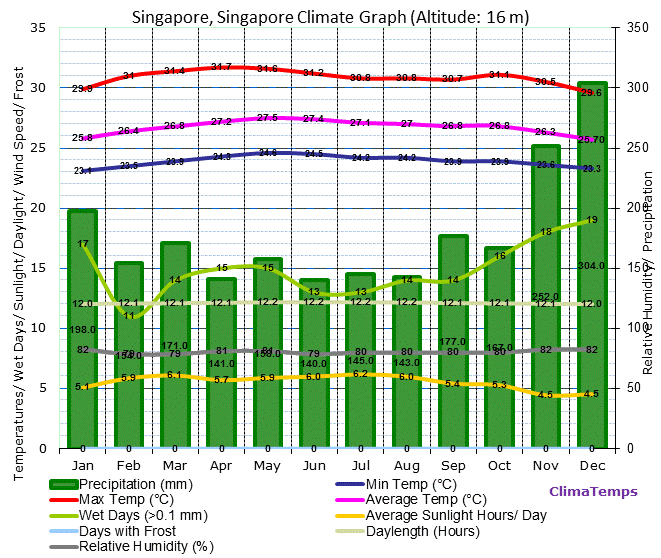
Singapore Weather & Updates
The Singapore (Paya Lebar) climate is characterised by uniform temperature and pressure, high humidity and abundant rainfall. The climate of Singapore can be divided into two main
seasons, the Northeast Monsoon and the Southwest Monsoon season, separated by two
relatively short inter-monsoon periods.
North-East Monsoon Season - December to early March - Northeast winds prevail,
sometimes reaching 20 km/h. Cloudy conditions in December and January with frequent
afternoon showers. Spells of widespread moderate to heavy rain occur, lasting from 1 to 3
days at a stretch. Relatively drier in February till early March. Also generally windy with wind speeds sometimes reaching 30 to 40 km/h in the months of January and February.
Pre South-West Monsoon - late March to May - Light and variable winds with afternoon and early evening showers often with thunder.
South-West Monsoon Season - June to September - Southeast/Southwest Winds. Isolated to scattered late morning and early afternoon showers. Early morning 'Sumatra' line squalls are common. Hazy periods.
Pre North-East Monsoon - October to November - Light and variable winds. Sea breezes in the afternoon. Scattered showers with thunder in the late afternoon and early evening.
Temperatures range from 19.4 deg C to 35.8 deg C. There is no distinct wet or dry season. Rainfall maximum occur in December and April. The drier months are usually in February and July.
seasons, the Northeast Monsoon and the Southwest Monsoon season, separated by two
relatively short inter-monsoon periods.
North-East Monsoon Season - December to early March - Northeast winds prevail,
sometimes reaching 20 km/h. Cloudy conditions in December and January with frequent
afternoon showers. Spells of widespread moderate to heavy rain occur, lasting from 1 to 3
days at a stretch. Relatively drier in February till early March. Also generally windy with wind speeds sometimes reaching 30 to 40 km/h in the months of January and February.
Pre South-West Monsoon - late March to May - Light and variable winds with afternoon and early evening showers often with thunder.
South-West Monsoon Season - June to September - Southeast/Southwest Winds. Isolated to scattered late morning and early afternoon showers. Early morning 'Sumatra' line squalls are common. Hazy periods.
Pre North-East Monsoon - October to November - Light and variable winds. Sea breezes in the afternoon. Scattered showers with thunder in the late afternoon and early evening.
Temperatures range from 19.4 deg C to 35.8 deg C. There is no distinct wet or dry season. Rainfall maximum occur in December and April. The drier months are usually in February and July.
=======================================================
Apologies for going missing for an extended period of time as I was swamped with materials to study as well as a hectic training schedule. Managed to clear CAAS Form 32 and Base Check, with the next stage being Base Training with the airline. The pace at which things went in the past six weeks was amazing and everything went by in a blink of an eye.
I'll try to keep up with the backdated posts and update this post with the links below.
Backdated Posts:-
Wednesday, April 22, 2015
New pilot school boosts Singapore's hub status

A NEW pilot school has opened near Changi Airport, boosting Singapore's status as a key training centre in a region where there is growing demand for cockpit crew.
Housed in a six-storey facility at Changi Business Park Crescent, the $95 million Haite Singapore Aviation Training Centre is owned by China-based aerospace firm Haite Group.
Catering mainly to airlines in South-east Asia, it has two flight simulators and aims to add five more over the next five years. With seven simulators, it will be able to provide about 50,000 training hours a year.
Haite Singapore managing director Marc Nadeau expects to secure its first airline customer over the next few days but declined to say which one.
It is the group's first such facility outside China where it currently trains more than 2,000 pilots and flight crew each year for airlines such as Air China, China Eastern and Philippine Airlines.
With airlines buying more aircraft, it is estimated that more than half a million new pilots will be needed globally in the next 20 years.
Four in 10 are expected to be hired by Asian carriers.
Singapore Technologies (ST) Aerospace also has a pilot training arm and in the first quarter of next year, Singapore Airlines and aircraft manufacturer Airbus will open their new pilot school at Seletar Aerospace Park.
Mr Nadeau said: "We have some very big players in the region but each player has its own particular role. We are addressing not just the commercial aviation market but also business aviation and the helicopter segment. This is where we distinguish ourselves. We address all aircraft types and all aircraft segments."
Speaking at the official opening of the facility yesterday, Senior Minister of State for Transport Josephine Teo said Haite is a welcome addition to Singapore's aviation industry, which has more than 100 companies offering a full suite of services, such as aircraft maintenance and repair, parts distribution, and aircraft leasing.
Ms Teo said the firm's presence here "is a testament to Singapore's importance as an aerospace hub for the region and an excellent example of how we can partner Chinese companies to facilitate their international expansion, especially into the growing South- east Asian market".
SOURCE
Friday, April 17, 2015
Batik Air flight makes emergency landing in Indonesia, no bomb found

An Indonesian Batik Air flight with 122 people on board made an emergency landing in Makassar in South Sulawesi after a suspected bomb threat, a government official said on Friday.
No bomb was found on the plane.
"I got a call from Sultan Hasanuddin airport in Makassar giving information about a bomb on Batik Air flight flying from Ambon to Jakarta," said J.A. Barata, spokesman for the transport ministry.
"Details on how they found out is unclear yet, I'm still waiting for information. The police is in charge of that now."
The plane was isolated from other flights and airport operations were not affected, said Tommy Soetomo, chief executive of airport operator Ankasara Pura I.
Batik Air is a subsidiary of Indonesian budget carrier Lion Air.
Thursday, April 16, 2015
Scoot to launch flights between Singapore and Kaohsiung

Scoot will launch flights between Singapore and the Taiwanese city of Kaohsiung from Jul 9 this year, the budget airline announced on Thursday (Apr 16).
The airline’s Boeing 787 Dreamliner aircraft will operate the thrice-weekly flights, said Scoot in a news release.
The Singapore-Kaohsiung flight will depart at 7:55am on Tuesdays, Thursdays and Saturdays from Jul 9. Meanwhile, the flight from Kaohsiung to Singapore will depart at 9:30pm on Tuesdays, Thursdays and Saturdays from Jul 9.
Scoot currently operates daily flights between Singapore and Taipei.
The jumbo jet faces a make or break year at Boeing, Airbus

The jumbo jet, for many years the workhorse of modern air travel, could be close to running out of runway.
Last year, there were zero orders placed by commercial airlines for new Boeing 747s or Airbus A380s, reflecting a fundamental shift in the industry toward smaller, twin-engine planes. Smaller planes cost less to fly than the stately, four-engine jumbos, which can carry as many as 525 passengers.
The slump in sales of the jets has raised questions over how long manufacturers can sustain production. It has also fueled internal debate in both companies over the future of the planes, sources said.
The outcome of those discussions will affect the value of existing fleets and thousands of production jobs at the plane makers and their many parts suppliers.
Sales forces at Airbus Group NV and Boeing Co are fighting for potential orders plane by plane as they seek to keep production going beyond the end of the decade, said other aviation market sources. The aircraft makers are offering discounts of at least 50 percent from catalog prices of around US$400 million for a jumbo jet, those sources said. Airbus has said it is also considering a revamp to make its 'superjumbo' more attractive to buyers.
Boeing in September plans to slow the pace of production of its latest 747-8 model to an average of 1.3 planes a month from 1.5 currently. At that rate the orders it already has in hand will only keep the production line going for 2 1/2 years.
The crunch, though, will come earlier because it can take up to two years from ordering the first part to finishing a jet, and no one wants to start the process if it is unclear whether the plane will be completed and delivered to a customer.
"I can see demand for the 747-8 in small numbers, but you have got to ask if they can keep the production line open if they don't get some new orders," said Tony Whitty, chief executive of UK-based aircraft re-marketing firm Cabot Aviation, which trades, manages and leases jets. "You also wonder at what price they are selling."
LONG DESCENT
Use of the 747 has dropped steadily over the last two decades, reflecting the rise of two-engine jets that have come close to matching its range. Over the same period production of large twin-engined jets like the Boeing 777 has risen seven-fold. Last year, Boeing booked 283 new orders for the 777 and now has a backlog of 547 orders.
Airbus is more upbeat than Boeing about the prospects for jumbo jets but both now agree it has become a niche category. Airlines still need jumbo jets but only for certain polar flights - where a two-engine jet may be less safe than a four-engine jumbo because of the lack of places for an emergency landing - and busy routes where landing slots are scarce.
The risk is most visible for Boeing, where investors could face a US$1 billion accounting charge if 747 production is shut down, according to company disclosures.
Boeing recently received a high-profile boost with a provisional order for two new jets to serve as Air Force One for the U.S. President but the 747's future depends a lot more on sales of the much-less glamorous windowless freight model. That has a unique hinged nose and can carry very large equipment, such as oil drilling rigs.
So far this year, Boeing has sold three. Atlas Air Worldwide recently said it plans to order more for its cargo fleet, but wouldn't say when or how many. The world's biggest 747 freight customer, Cargolux , also says it likes the plane, but has a pending order for only three.
A sustained upturn in air freight traffic could secure the 747 a longer future. International freight traffic rose 4.8 percent last year, but volume has only just recovered from a collapse in 2009 during the financial crisis.
CARGO HAULER
Boeing reckons some 143 older freighters will need to be replaced, stretching demand for the 747 through the 2020s, the program vice president, Bruce Dickinson, said in an interview.
"We know there is a long-term market for this airplane and some of the unique things it can do," Dickinson said from his office overlooking the 747 production line at the giant Everett plant near Seattle.
But Boeing’s effort to sell new 747s is overshadowed by the many older 747s available for lease, which have suddenly been made more attractive because of a big slide in fuel prices since the middle of last year. Leasing companies say there is scant interest in new 747-8s when 82 freighters are baking in desert parking lots.
The older planes can be leased for as little as US$400,000 a month, compared with up to US$1.4 million in monthly lease payments for a new 747-8 freighter, experts say.
"That's a pretty big difference," said Gueric Dechavanne, vice president at Collateral Verifications, a Connecticut-based aircraft appraisal firm.
Some companies have extended 747 leases for three to four years, said Aengus Kelly, chief executive of leasing company AerCap .
"It's a challenge to lease a freighter," Kelly told Reuters. "It's definitely a challenge to sell them."
Airbus’s A380 is a newer plane – its first flight was almost exactly 10 years ago - and has become a mainstay of Middle East carriers that offer opulent suites to first class passengers. But the drop in demand is prompting Airbus to weigh whether to revamp the plane with new engines, or carry on with the existing model.
Airbus has 161 orders for the planes in hand, or more than five years of production. But it acknowledges that not all of those jets will be delivered, leaving it with barely three years of guaranteed output. Given the long lead times, Airbus must bring in more orders soon to avoid having to taper production.
“We are always looking at product improvements, but there is so much untapped potential in the existing aircraft,” said Airbus marketing head Chris Emerson.
Airbus could announce an A380 revamp as early as the Dubai Airshow in November, but must first find a way to assure investors it can recover several billion dollars of development costs, sources said. Analysts say on option could be to apply for more European government loans, though that risk
s exacerbating trade tensions with the United States.
Top customer Emirates is offering to double its planned purchase of 140 A380s if Airbus carries out the improvements, which the Dubai carrier’s Chief Executive Tim Clark tells Reuters will be "extremely good for the (airline’s) bottom line."
But Airbus’s board is unlikely to back a new A380 model for just one customer.
Subscribe to:
Posts (Atom)